

Traffic on a flyover, an aircraft on approach, the rumble of a metro line two streets away. Urban noise is now one of the most common complaints in Indian residential and commercial buildings, and glazing is usually the weakest link in the envelope. Acoustic glass, commonly called soundproof glass, is the most effective glazing-led fix, and the right combination of laminated glass and double glazed glass can cut transmitted noise dramatically without compromising daylight or views.
This guide explains how acoustic glass works, the ratings that matter, the configurations to specify for hospitals, schools, hotels, and noise-sensitive residential projects, and how to avoid the common mistakes that kill acoustic performance in the field.
What is Acoustic Glass?

Acoustic glass is a category, not a single product. It covers laminated glass with acoustic PVB interlayers, asymmetric double glazed units (DGUs), and combinations of the two, all engineered to reduce airborne sound between two spaces.
A sound wave hitting a glass pane makes it vibrate, transmitting the sound to the other side. Acoustic glass interrupts this by absorbing vibration through a viscoelastic interlayer, decoupling two panes across a sealed cavity, and using dissimilar pane thicknesses so each pane resonates at a different frequency.
A standard 6 mm float pane offers around 30 dB of sound reduction (Rw). A well-designed acoustic laminated DGU can achieve 45 dB or more, the difference between hearing traffic clearly and barely noticing it.
How Soundproof Glass Reduces Noise

Soundproof glass works through three mechanisms: mass, damping, and decoupling.
Mass
Heavier panes reduce sound better. Doubling pane thickness improves insulation by roughly 5 to 6 dB, which is why 8 mm, 10 mm, or 12 mm panes outperform 4 mm. The human ear hears from 20 Hz to 20,000 Hz but is most sensitive between 2,000 Hz and 5,000 Hz, the speech recognition range driven by ear canal resonance. Thicker panes perform better in this range because their coincidence frequency (the point where glass becomes acoustically weak) is lower: around 3,500 Hz for 4 mm glass, sitting right in the ear's peak sensitivity zone, versus around 1,300 Hz for 10 mm glass, well outside it. This is why thicker glass delivers a noticeably greater perceived noise reduction.
Damping
Every pane has a "coincidence frequency" where it becomes acoustically transparent. A PVB interlayer dampens this resonance, and acoustic PVB does it significantly better.
Decoupling
In a double glazed unit, two panes separated by a sealed cavity act as independent masses. Sound must vibrate one pane, cross the cavity, and vibrate the other, losing energy at each step. Dissimilar pane thicknesses amplify the effect.
Acoustic Laminated Glass: The PVB Advantage
In laminated glass, the PVB interlayer is what does the acoustic work. Standard PVB already outperforms monolithic glass of the same thickness because it dampens the coincidence dip. Acoustic PVB is a tri-layer interlayer with a softer viscoelastic core that absorbs vibration far more effectively, adding another 2 to 5 dB of sound reduction across the audible range, with the biggest improvement in the speech band (500 Hz to 4 kHz).
Typical acoustic laminated configurations:
- 9.12 mm (4+1.12 acoustic PVB+4): around 38 to 39 dB Rw
- 11.12 mm (5+1.12 acoustic PVB+5): around 40 dB Rw, common in hotels and clinics
For a broader look at laminated glass construction, interlayer types, and safety performance, read our guide on laminated glass.
Acoustic Double Glazed Glass: Decoupling and Asymmetry
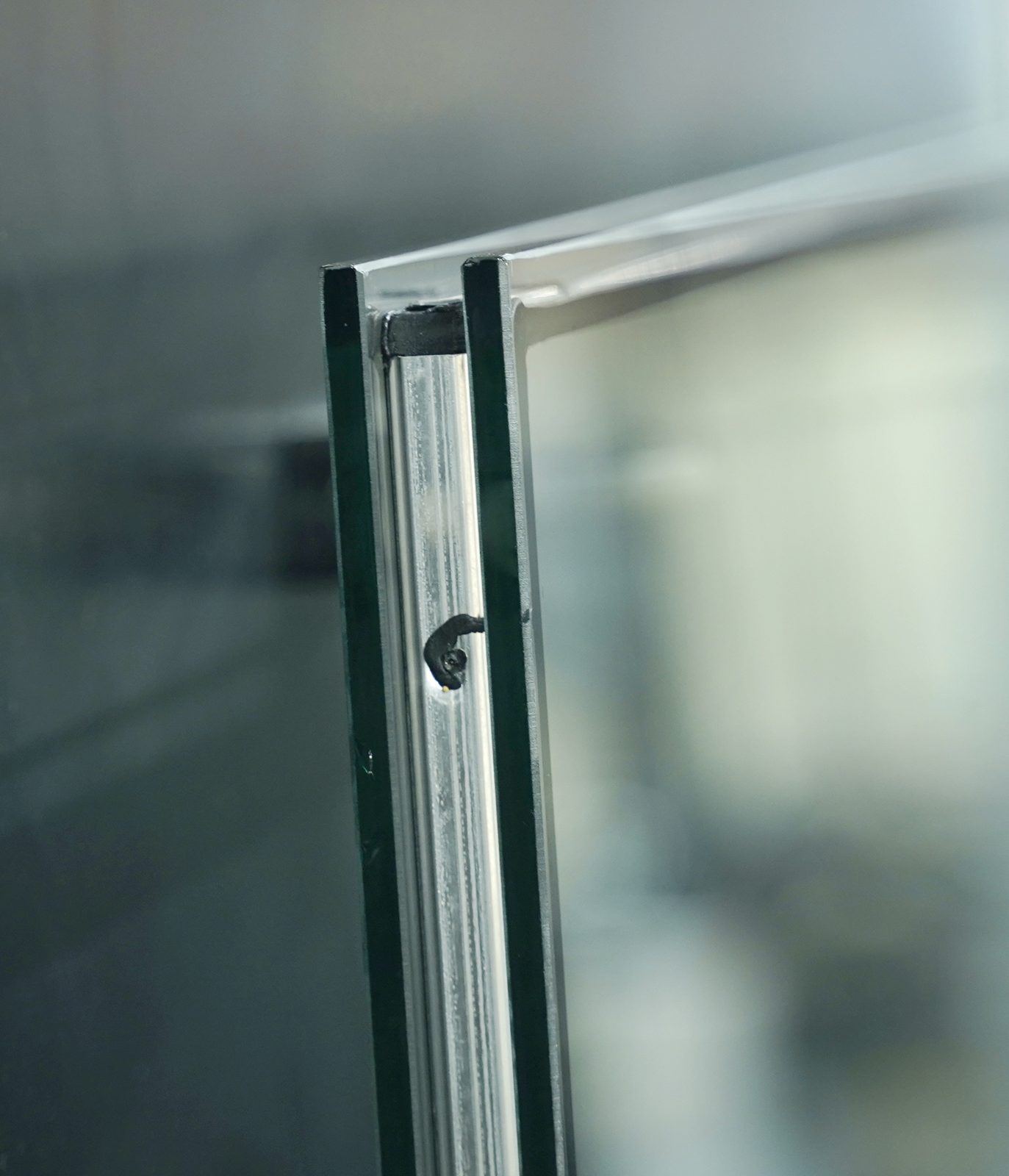
A double glazed glass unit takes acoustic performance further by separating two panes across a sealed cavity. Three design choices drive the result.
Pane asymmetry
Use two panes of different thickness so each has a different coincidence frequency. A typical recommendation is 4 mm + 12 mm cavity + 8 mm, or 4 mm + 16 mm cavity + 12 mm for demanding applications. A thickness difference of at least 4 mm between the panes is most effective. The larger the air gap, the better the acoustic performance.
Cavity width and gas fill
Gains beyond a 12 mm cavity are modest. Argon fills improve thermal performance but make almost no difference acoustically. Prioritise asymmetry over cavity width or gas fill.
Acoustic laminated DGU
The highest-performing combination pairs asymmetry with an acoustic laminated pane. A 6 mm + 12 mm cavity + 9.12 mm acoustic laminated unit delivers around 45 dB Rw, suitable for airports, studios, and premium hotel suites.
Sound Reduction Ratings: Rw, STC, and What They Mean
Acoustic glass carries several performance ratings, and architects need to request the right one.
| Rating | What It Measures | Standard |
|---|---|---|
| Rw (Weighted Sound Reduction Index) | Single-number sound insulation across 100 Hz to 3.15 kHz | ISO 717-1 |
| STC (Sound Transmission Class) | American equivalent of Rw, measured across 125 Hz to 4 kHz | ASTM E413 |
| Rw + Ctr | Rw with correction for low-frequency traffic noise | ISO 717-1 |
| Rw + C | Rw with correction for general indoor noise | ISO 717-1 |
For Indian projects facing road and rail traffic, Rw + Ctr is the most relevant rating because it captures low-frequency performance. As a rule of thumb, a 10 dB reduction in Rw is perceived as roughly halving the loudness of the unwanted sound.
Acoustic Glass Performance by Configuration
| Glass Configuration | Approximate Rw (dB) | Suitable For |
|---|---|---|
| 6 mm float glass | 30 | Standard windows, low-noise environments |
| 6.38 mm laminated (standard PVB) | 33 | Residential windows on quiet streets |
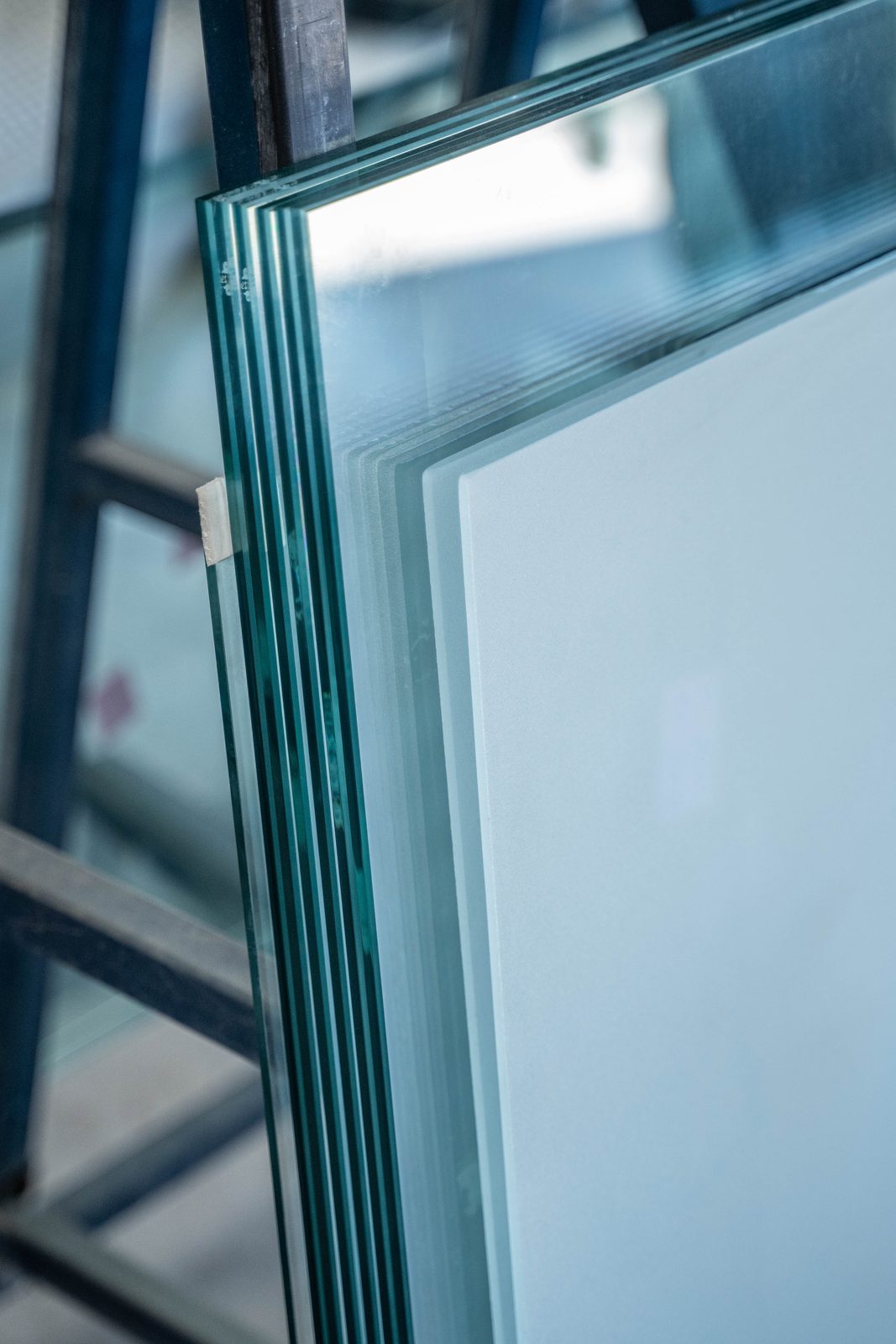
| 9.12 mm acoustic laminated | 38-39 | Urban residential, schools, offices |
| 4-12-6 mm DGU (asymmetric) | 35-37 | Commercial offices, moderate traffic |
| 6-12-9.12 mm acoustic laminated DGU | 42-45 | Hotels, hospitals, premium residences |
| 8-16-12.76 mm acoustic laminated DGU | 45-50+ | Airports, studios, high-noise zones |
Rated values assume a correctly detailed frame and installation. The glass is only as effective as the weakest link in the window assembly.
Where to Use Acoustic Glass: Applications by Industry

The right specification depends on the noise source, the activity inside, and the regulatory environment. Human hearing is not linear, even a few decibels of improvement can feel noticeably quieter in a real room. The difference on paper may look small, but the difference in comfort is significant.
For a broader view of glazing selection that balances acoustic, thermal, and safety requirements, read our guide on how to choose the right glass for your building project.
Specifying Soundproof Glass: Key Considerations
Acoustic glass only delivers its rated performance when the whole window system supports it.
- Frame and gasket quality: A leaky frame costs 5 to 10 dB. Specify high-quality EPDM gaskets and proper compression seals.
- Avoid trickle vents: Any opening in the glazing assembly is a direct sound path. If ventilation is required, use acoustic baffles.
- DGU edge sealing: The secondary seal must be intact to prevent acoustic leaks.
- Asymmetric panes: Always specify dissimilar pane thicknesses in acoustic DGUs.
- Acoustic PVB by name: Standard PVB is not the same as acoustic PVB. Call it out explicitly in the glass schedule.
- Verify with Rw + Ctr: For traffic-facing facades, request the Rw + Ctr value, not just Rw.
- Pair with safety glass requirements: For balustrades and overhead glazing, confirm the acoustic configuration also meets IS 2553.
Indian Standards for Acoustic Glass
Key references when specifying acoustic glass in India:
- IS 2553 (Part 1): 2018 — safety glass specification; BIS/ISI mandatory for laminated glass in human impact zones.
- IS 16231 (Parts 1 to 4): 2019 — code of practice for the use of glass in buildings.
- NBC 2016 (Part 8, Section 4) — acceptable indoor noise levels for residential, commercial, and healthcare buildings.
- ISO 717-1 and ISO 10140 — laboratory measurement and rating of sound insulation; the basis for Rw values on glass data sheets.
For IGBC and GRIHA projects, acoustic comfort credits often require glazing assemblies to meet specified Rw or STC targets.
Why Choose Karnataka Metal Company for Acoustic Glass?
As one of South India's established integrated glass and aluminium companies, Karnataka Metal Company delivers acoustic glass engineered for the real noise environment of Indian cities, where low-frequency traffic and rail noise is the dominant problem. Hitting a 40 to 45 dB Rw target reliably takes more than specifying an interlayer; it takes disciplined processing, precise lamination, and a framing system that does not leak sound.
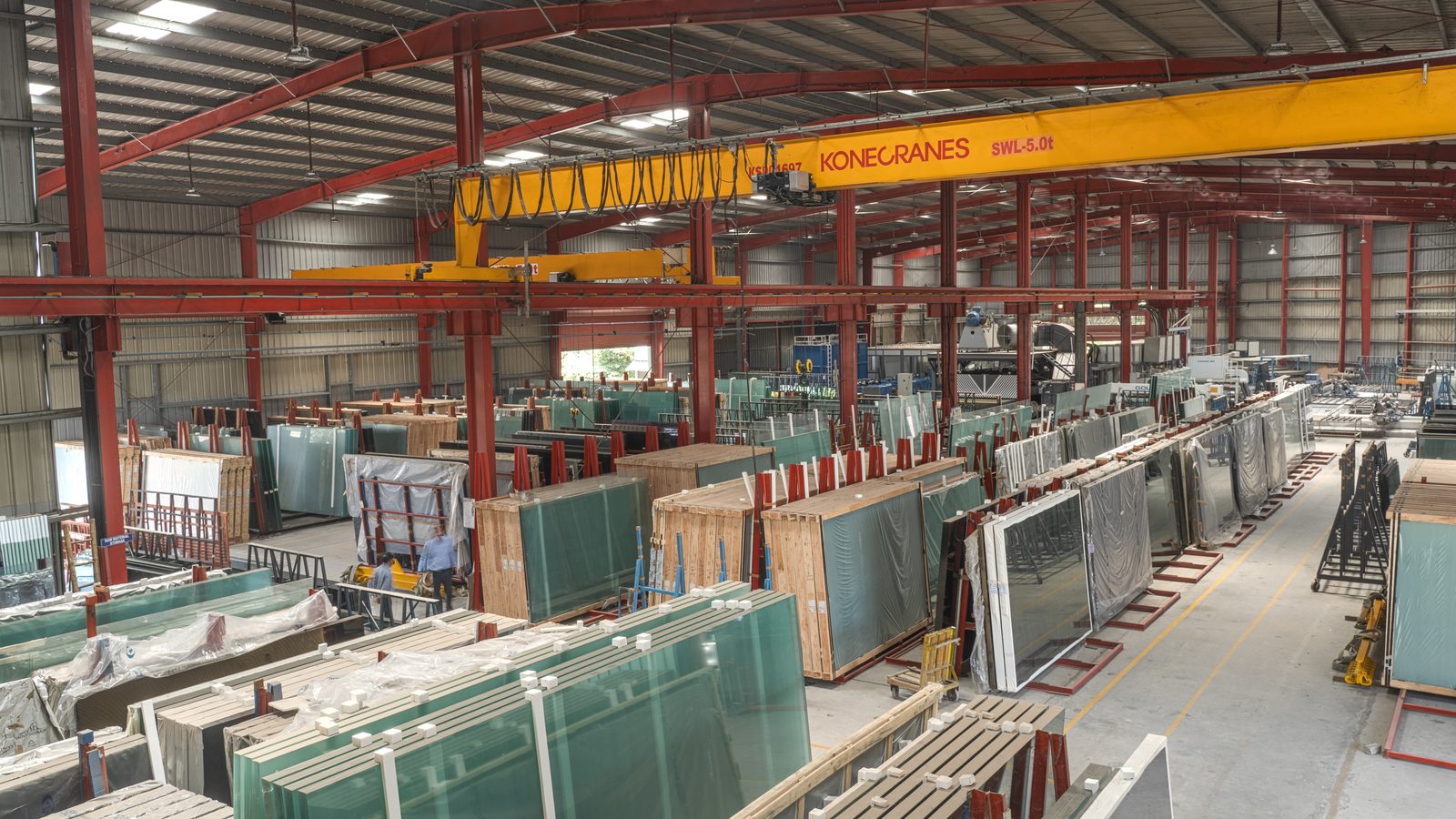
Our 50,000 sq ft glass processing facility in Nelamangala, Bangalore, runs automated double-glazed glass assembly and in-house, high-quality, tempering, giving us control over the critical layers of an acoustic build-up.
We offer glass lamination through quality-tested service providers for PVB, acoustic PVB, and SGP bonding. Lamination quality depends on the flatness of the tempered or heat-strengthened glass. Bubbles and delamination are common risks when the glass is not flat enough. Our facility produces some of the flattest glass in the industry, which helps mitigate these risks and deliver high-quality laminated glass.
Acoustic performance is only as good as the weakest part of the window, so we run every build through in-house tempering, DGU assembly, and edge sealing with tight process control and consistent quality checks.
- ISO 9001:2015 & ISO 14001:2015 and BIS/ISI certified facility, compliant with IS 2553 (Part 1): 2018 for safety glass
- Asymmetric DGU configurations (laminated + monolithic, dissimilar pane thicknesses) tuned for Rw + Ctr on traffic-facing facades
- Large-size processing: toughened and heat-strengthened up to 2800 × 5000 mm, laminated up to 2400 × 5000 mm, and DGUs up to 64 mm thickness
- Heat-soaked toughened plies on request, reducing NiS-related breakage risk on critical acoustic laminated facades
- In-house testing to IS and EN standards, with dimensional, edge-quality, and process checks on every batch
- Large inventory and sourcing network for reliable supply on both project-scale and smaller acoustic window orders
As an integrated supplier, we also provide aluminium profiles and machining services from the same Bangalore campus, so the glass and the framing system are coordinated together.
Get in Touch
Contact us for acoustic glass selection guidance and competitive pricing.
- Phone: +91 80 2670 9928
- Email: sales@karnatakametal.com
- Visit us: 16 & 17, A.M Road, Kalasipalya Extension, Bangalore 560002
Get in touch for a consultation and quote.